

Living in Mexico, I’m worrying about something that I’d never worried about before—being handed counterfeit pesos. Fortunately, there are a few simple things you can do to protect yourself from financial loss.
To be honest, I hadn’t thought about counterfeit money since receiving some fake pesos (the Argentine variety) from a taxi driver in Buenos Aires about 15 years ago. I’d never even seen this problem mentioned anywhere in the Mexican press.
Then a few weeks ago, articles started popping up all over the place, declaring not only that counterfeit money is a problem in Mexico, but that it’s getting worse.
How Big a Problem is Counterfeit Money in Mexico?
According to Mexico’s central bank (often referred to as “Banxico”), counterfeit pesos in circulation reached a three-year high in 2025. But the risk isn’t evenly distributed.
Which bills are the most frequently forged? These notes in particular merit extra close attention:
- $500 Peso notes are the most often forged, accounting for roughly half of all counterfeit bills in circulation last year.
- $100 Peso notes are the second most forged note, with an increase of more than 200% in 2025.
- $200 Peso notes, previously the most popular target, have dropped to third.
Counterfeit money has been a problem in Mexico for nearly a century. In the most famous case involving forged banknotes, a talented French artist named Alfredo Héctor Donadieu, aka “Enrico Sampietro” was arrested in Mexico City back in 1934 for producing very high-quality fake money, both Mexican and foreign. He was imprisoned twice and eventually deported back to his native France.
In modern times, the Mexican government office charged with investigating and prosecuting counterfeiting is the Attorney General’s office (FGR in Spanish). Typically, it works closely with the Banco de México and the Federal Police on such cases.

Counterfeit currency is most common in Mexico City (CDMX), followed by Mexico State (Edomex, the area surrounding the Mexican capital). Unfortunately, my state of Jalisco (home to Guadalajara, Lake Chapala, and Puerto Vallarta) ranks third. These three states account for roughly half of all the fake currency circulating in Mexico, according to Banxico, Mexico’s Central Bank.
When I asked a friend who’s lived in Guadalajara most of her life if she’d ever received counterfeit money here, she laughed and said yes, many times. When she’d worked as a bartender back in her 20s, she not only had customers passing fake bills, but she’d also received forgeries for her wages. Her boss was undoubtedly trying to recycle garbage money the business had received from customers.
How to Identify Real Mexican Pesos
Genuine Mexican banknotes have a special texture that you can feel, because they’re made of cotton and polymer. It’s one of the easiest ways to distinguish a real banknote from a counterfeit one.
In addition, raised print (for those who are visually impaired) is used for note denominations and signatures, allowing you to easily check their authenticity by running your finger over them.
When viewed against a light, you will also see these features on genuine Mexican banknotes:
- Microprinted security threads that change color when the paper is moved. This is especially difficult to reproduce without specialized technology.
- The ink glows under ultraviolet light.
- Tiny, almost imperceptible numbers showing the name and series. (A magnifying glass is needed for this)

How to Spot Fake Mexican Pesos
Because the circulation of counterfeit bills in Mexico continues to rise, it’s crucial to learn the telltale signs to avoid being ripped off.
Below are some of the most common flaws observable with fake notes:
- The paper’s texture feels smooth, like regular paper.
- When your finger touches the main numbers and text, there is no texture.
- The color on one side does not match the color on the other.
- Faces or monuments in the design don’t look crisp. They’re blurry.
- When held up to the light, there are no watermarks. This is an image visible on both sides of the banknote. Some counterfeit banknotes have a watermark, but on genuine banknotes, the image shows distinct tones and details.
If you notice any of these things when receiving money at a street market, from a taxi driver, or from any individual or business, decline it and ask for a replacement.
For those who work in Mexico and handle cash regularly, it may also be worth buying a small, portable UV lamp or a specialized marker pen like Check It to verify that the currency you receive is authentic.
Bottom line: The best way to avoid becoming a victim of counterfeiters is to study the traits of genuine Mexican banknotes and examine the money you’re handed in the course of your daily activities.
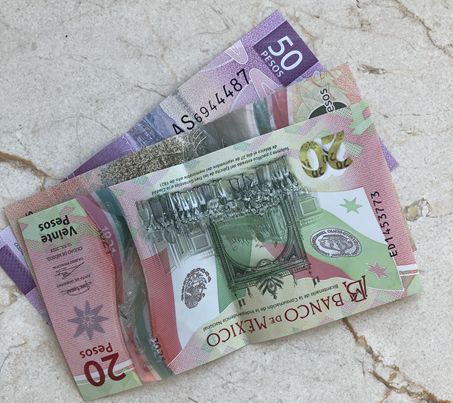
What You Should Do If You Think You Have Counterfeit Pesos
If you think you have a banknote or coin that’s counterfeit, do not use it.
Making payments with counterfeit money in Mexico is a federal crime punishable by up to 12 years in prison, though in practice the feds normally go after organized crime groups with large-scale operations, not individuals.
If, when making a payment, you are told that any of your bills appear counterfeit, ask for them back. Only banks are authorized to retain suspected counterfeit currency.
To verify that a banknote is false (or authentic), take it to your bank and ask that they send it to the Bank of Mexico for analysis (this is something the bank must do for free). In exchange, the bank must provide a form called “Receipt for Retention of Suspected Counterfeit or Altered Currency,” sometimes referred to as “Annex 6.”
The receipt should include a Currency Authentication System number (“SAM Receipt Number”), which allows you to track your currency. It is also important that both you and the teller who retains the currency write your names and sign the form.
It could take as long as 30 days for Banxico to report its findings. To learn the result, inquire at the bank you turned the bills into.
If they’re authentic, the bank will reimburse you for that amount. If the bills are deemed counterfeit, the Bank of Mexico will retain them, and it’s a total loss for you.
Are Mexican Banks Part of the Solution, or Part of the Problem?
In practice, a Mexican bank is highly unlikely to complete the steps outlined above, unless you are a lucrative client and insist on action being taken. The reason is that counterfeit money is common enough that they likely won’t see it as something worth their time to investigate.
Think that’s too cynical? Maybe this story will change your mind.
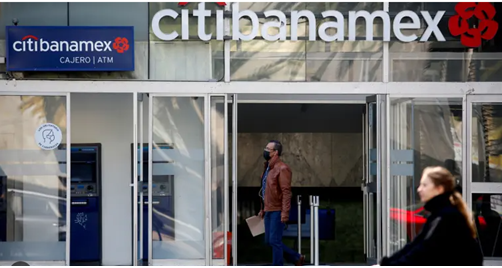
The same friend who told me about the fake money she’d received while bartending also shared that during the pandemic, her mom had received fake money from a Banamex ATM in Guadalajara.
Wait, what? Her mom received fake banknotes from the second-largest bank in Mexico?
Now, if anyone should know they’ve got fake banknotes in their possession, it’s a major Mexican bank. I’ll let you draw your own conclusions about why and how that happened at Banamex. (back then, it was CitiBanamex)
Upon discovering the bills looked sketchy, the woman was pretty annoyed and returned to her bank to report the incident. At the teller window, she showed the employee the questionable notes, stating she’d received them from the bank’s own ATM.
The teller examined her bills, agreed they were fake, and thanked her for bringing them in. No reports were filed. The bank didn’t apologize for the error, and it certainly didn’t replace the woman’s counterfeit bills with authentic ones.
Banamex had effectively robbed this woman… twice.
Is it any wonder why so many older Mexicans still prefer to stash money under their mattress instead of in a traditional bank?
Since I hate to carry cash, the counterfeit money problem strikes me as an excellent reason to rely more on electronic payments and credit cards. Just be on the lookout for dynamic currency conversion, so you don’t overpay.