
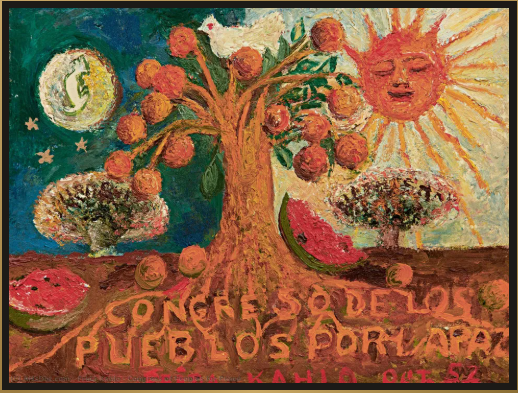
If you are a long-time reader of my blog, you may remember the story of Hilda Trujillo Soto (former director of Casa Azul), who accused museum insiders of stealing multiple Frida Kahlo works from the museum’s collection.
It’s a story I first covered in a post last December.
A few days ago, another installment of this telenovela dropped (like a bomb) when the New York auction house Christie’s announced the sale of one of the missing Frida Kahlo paintings, The Congress of Peoples for Peace (el Congreso de los Pueblos por la Paz), and then abruptly cancelled the auction.
The Backstory to this Missing Frida Kahlo Painting
Frida Kahlo painted this famous work in 1952, just two years before her death. Back in 1955, it was part of a vast collection of art and personal items Diego Rivera bequeathed to the Mexican state, with the explicit directive that none of the items should ever be removed from Mexico City’s Casa Azul, which is now a world-famous museum.
The Congress of Peoples for Peace painting did in fact remain in Casa Azul’s collection for many decades. And then, mysteriously, it disappeared.
Casa Azul’s leadership discovered this painting was no longer in the museum’s collection back in 2011 during its first audit in more than 50 years. It found multiple discrepancies between the current collection and the original inventory of Kahlo’s works cataloged by none other than Diego Rivera himself in 1957.
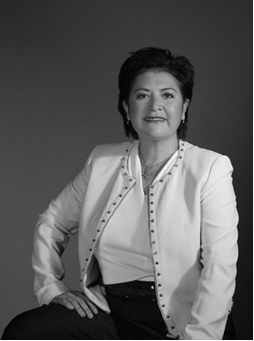
Hilda Trujillo Soto, who worked at Casa Azul from 2002 to 2020 (during her last 11 years there she was museum director), took her accusations about the stolen art public in April 2025. In a meticulously detailed blog post she described the works that disappeared and who was in a position to know what happened.
In response, the Mexican government dismissed her claims as those of a disgruntled ex-museum employee. To learn more about what the audit found (and what museum trustees did next), read my previous post.
Art Thieves and the Crooked Dealers Who Enable Them
Christie’s aborted sale of The Congress of Peoples for Peace wasn’t even the first time the painting had surfaced in a public art auction. In June 2020, when most of the non-essential U.S. economy was shut down, the same painting was sold for $2.66 million by Sotheby’s New York to an anonymous private collector.
With most attention focused on the Covid-19 pandemic in 2020, no one protested its sale. But this time was different.
So, what happens next?
Ideally, there would be an investigation into the anonymous seller who brazenly took the painting to Christie’s to auction off. When his or her claim of ownership rests on such shaky ground, why should they be shielded from scrutiny?
But I won’t hold my breath.
Major auction houses routinely maintain the anonymity of sellers to protect their privacy. Courts in New York have also upheld that auction houses do not have to disclose seller identities, which helps to perpetuate these illicit practices.
Another skeptic is Gabriela Mosqueda, a Mexican curator who has been involved in a campaign to protect Mexico’s cultural patrimony. She told the New York Times this week that the Mexican government should demand that the painting’s owner return it if unable to prove a clean provenance.
But she conceded that was unlikely, saying, “I have little hope that the [Mexican] government will put its house in order.”
Mexico’s government obviously has a full plate of pressing issues in the age of Trump 2.0. And yet doing nothing seems untenable.
Foul play was indirectly confirmed last year when INBAL, the Mexican agency tasked with safeguarding the country’s artistic heritage, stated publicly that it has never issued a permit for the permanent export of any Kahlo paintings.
This mess reminds me of an episode in Season 1 of HBO’s dark comedy “Your Friends & Neighbors” where the pawnbroker Lu emphatically warns Coop (played by Jon Hamm) against stealing a Roy Lichtenstein painting sitting in one of his neighbor’s homes:
“These art guys, they’re a different breed. I’m telling you – they’re savages.”
I couldn’t agree more.